You're here:
Best Sales Tax Software in 2026: 10 Tools Compared
In this article
- How we compared these tools
- Best sales tax software at a glance
- 1. Quaderno: best for selling internationally
- 2. Avalara: best for enterprises with an ERP
- 3. Stripe Tax: best if you are already on Stripe
- 4. TaxJar: best for existing customers, not new ones
- 5. Anrok: best for SaaS taxability questions
- 6. Numeral: best for predictable per-filing pricing
- 7. TaxCloud: best if you qualify for free SST filing
- 8. Vertex: best for large in-house tax teams
- 9. QuickBooks Online: best if your books are already there
- 10. Xero: best if you accept the Avalara dependency
- How to choose sales tax software
- What sales tax software will not do for you
- Which sales tax software should you choose?

In Illinois, a Twix bar is food and a Snickers bar is candy, so they are taxed differently. The difference is flour. Texas taxes plain deodorant at 6.25% and antiperspirant at nothing. New Jersey taxes yarn bought for an art project but not yarn bought for a sweater. Chief Justice Roberts put all three in his Wayfair dissent to make one point: over 10,000 jurisdictions levy sales taxes, each with different rates, different exemptions and different product definitions. Nobody tracks that by hand.
Short answer: the best sales tax software is the one that matches where you have obligations. Quaderno if you sell internationally, TaxCloud or Numeral if you only sell in the US, Avalara or Vertex if you run an ERP.
This comparison covers ten sales tax compliance platforms. Every one of them does the same four things at a minimum: monitor thresholds, classify products against local tax laws, calculate the rate at checkout, and produce a return. Where they diverge is everything after that.
Every price below was checked against the vendor's own pricing page in September 2026. Most comparisons on this subject are still quoting numbers that expired two years ago. We make one of these tools, and we have said where it is the wrong choice.
How we compared these tools
Six questions, asked of every platform.
- What does it cover? US sales and use tax only, or international VAT and GST as well.
- What does it automate, and what does it only report on? Tax calculations are table stakes. A tool that stops there is a very different product at a very similar price.
- Does it file and remit, or hand you a return? The sharpest line on this list.
- Does it handle exemption certificates? Decisive if you sell B2B or wholesale, irrelevant otherwise.
- What happens in an audit? Whether the vendor reconstructs your filing history, and whether audit support costs extra.
- Is the price published? "Custom quote" is recorded as custom quote. We did not estimate.
Pricing came from each vendor's own published page in September 2026. Where a vendor publishes nothing, we say so rather than repeating a figure from a review site. Sales tax compliance is one of the few software categories where half the market still refuses to publish a price, and that is itself a buying signal.
One disclosure, up front. Quaderno published this, and Quaderno is first on the list. Every entry, ours included, carries a section on where the tool falls short, so you can weigh the recommendation against the admission. Income tax and tax preparation software are out of scope; they solve a different problem.
Best sales tax software at a glance
The column that matters most is not features or price. It is whether the tool actually files.
| Software | Best for | US sales & use tax | International VAT/GST | Files for you | Invoicing | Starting price |
|---|---|---|---|---|---|---|
| Quaderno | Selling internationally | ✓ | ✓ | ✓ | ✓ | $29/mo |
| Avalara | Enterprises with an ERP | ✓ | ✓ | ✓ | ✗ | Custom |
| Stripe Tax | Businesses already on Stripe | ✓ | ✓ | Paid tier | ✗ | 0.5%/txn |
| TaxJar | Existing customers | ✓ | ✗ | Per filing | ✗ | $39/mo |
| Anrok | SaaS taxability questions | ✓ | ✓ | ✓ | ✗ | $50/market/mo |
| Numeral | Predictable per-filing costs | ✓ | ✗ | ✓ | ✗ | $75/filing |
| TaxCloud | Sellers who qualify for SST | ✓ | ✗ | ✓ | ✗ | $39/mo |
| Vertex | Large in-house tax teams | ✓ | ✓ | ✓ | ✗ | Custom |
| QuickBooks Online | Books already in QuickBooks | ✓ | ✗ | ✗ | ✓ | $38/mo |
| Xero | Books already in Xero | ✓ | ✓ | Via Avalara | ✓ | $25/mo |
Here is each one in detail, starting with the caveat that we built the first.
1. Quaderno: best for selling internationally
Most tools on this list solve one country. Quaderno solves selling in several at once, which is where almost every SaaS company and digital seller ends up, planned or not.
Key features
- One platform for US and international obligations. Sales and use tax, EU VAT, UK VAT and GST, in more than 12,000 jurisdictions, without a second vendor.
- Threshold tracking in both directions. Economic nexus across US states and registration thresholds abroad, monitored in real time and flagged before you cross them.
- Tax-compliant invoicing built in. Invoices carry the right tax breakdown, in your customer's language and currency, and are archived for the retention period their country requires.
- Filing or reporting, your choice. Quaderno can file tax returns on your behalf, or produce return-ready reports for you or your accountant.
- Registrations handled. When a new jurisdiction is triggered, we register you there.
Integrations
Around 20 native connections, in three groups:
- Payments: Stripe, PayPal, Braintree, GoCardless, Square
- Commerce: Shopify, WooCommerce, Amazon FBA
- Creator platforms: Teachable, Kajabi, Thinkific, SendOwl, LearnWorlds, Podia
That last group is the one other vendors ignore. There is also a developer-first API if none of those fit.
Pricing
- Hobby: $29/month, 25 transactions, one jurisdiction
- Startup: $49/month, 250 transactions, unlimited jurisdictions
- Business: $99/month, 1,000 transactions
- Growth: $149/month, 2,500 transactions
- Enterprise: talk to a specialist above 2,500 transactions
Where Quaderno falls short
We do not manage exemption certificates. If you sell wholesale or B2B into the US and need certificates collected, validated and renewed, Avalara or Numeral will serve you better. We are also not an ERP tax engine: if your tax logic has to live inside SAP or Oracle, that is Vertex territory. And because plans are priced on transaction volume, a high-volume, low-ticket seller will find per-filing pricing cheaper than ours.
See whether Quaderno actually fits
Free for 7 days, no credit card. Connect Stripe or Shopify and watch it calculate tax on your own transactions before you decide.
Start your free trial2. Avalara: best for enterprises with an ERP
Avalara is the reference implementation of tax compliance software. It is also the most expensive way to solve a problem that many readers of this post do not have.
Key features
- AvaTax calculation across US and international jurisdictions, called in real time from your commerce stack.
- CertCapture for exemption certificates: collection, validation, expiry tracking and renewal. Genuinely best in class.
- Returns and remittance filed on your behalf, with reconciliation against what was calculated.
- Business license and registration services, which most competitors treat as someone else's job.
- Audit documentation, with transaction-level records you can still pull years after the fact. Audit defense is a paid add-on rather than a default.
Integrations
Deep connectors into NetSuite, Microsoft Dynamics, Sage Intacct, Shopify, BigCommerce and QuickBooks, plus certified partner builds for most mid-market ERPs. Worth knowing: Xero's US auto sales tax runs on Avalara underneath, so a fair number of readers are already Avalara customers without having chosen it.
Pricing
Avalara publishes three fixed prices and quotes everything else. License guidance starts at $119, sales tax registration is $403 per location, and a bundled calculation-and-returns package starts at $699. AvaTax itself is quoted per deal, based on transaction volume, jurisdiction count and how many applications you connect.
Where Avalara falls short
The pricing is not knowable in advance, which makes budgeting hard for a company without a procurement function. Implementation and premium support sit outside the license fee. There is no invoicing. And the feature set that justifies the cost, certificate management and ERP-grade connectors above all, is not the feature set a seller registered in five states actually needs.
3. Stripe Tax: best if you are already on Stripe
Stripe Tax has the shortest setup of anything here, because if Stripe is already your processor there is nothing to integrate. You switch it on.
Key features
- Geolocation calculation applied at checkout from the customer's location, with no rate tables to maintain.
- Threshold monitoring across US states and international registration thresholds, surfaced in the Stripe dashboard.
- Real-time breakdowns shown to the customer at the point of payment.
- Filing on the paid tier, covering registrations and returns in a wide set of countries.
Pricing
Two tiers. Tax Basic is 0.5% per transaction on payments processed through Stripe, with transactions from other sources billed per API calculation call. Tax Complete is a subscription that adds registrations and filings across 90+ countries, priced by registration count and volume.
The arithmetic matters here, because percentage pricing is cheap while you are small and punishing once you are not.
| Monthly volume through Stripe | Stripe Tax at 0.5% | Quaderno Growth ($149 flat) |
|---|---|---|
| $10,000 | $50 | $149 |
| $30,000 | $150 | $149 |
| $100,000 | $500 | $149 |
| $200,000 | $1,000 | $149 |
The crossover is around $30,000 a month. Above that, every flat-rate tool on this list is cheaper than Stripe Tax, and the gap widens the faster you grow.
Where Stripe Tax falls short
It sees Stripe. Sell through Stripe and Amazon and a wholesale channel, and Stripe Tax has a partial view of your liability. A partial view is what produces a surprise assessment. It does not issue invoices that satisfy EU or Latin American invoice rules. And the pricing model charges you more precisely as you grow.
4. TaxJar: best for existing customers, not new ones
Every stale comparison still lists TaxJar at $19 a month. That number is two price changes out of date, and the product's strategic position has changed more than its price.
What changed
Stripe acquired TaxJar in 2021. Since then, new sign-ups have been steered toward Stripe Tax, and TaxJar stopped offering international VAT and GST calculation to new accounts in September 2025. It is a US product now, maintained for the customers it has.
Key features
- AutoSync pulling orders from Amazon, Shopify, eBay and other channels into one liability view.
- Economic nexus alerts when you approach a state threshold.
- AutoFile for automated return submission, sold as credits.
- A filing dashboard that is still, genuinely, one of the clearest interfaces in this category.
Pricing
- Starter: $39/month for 200 orders, 2 AutoFile credits a year, $50 per additional filing
- Professional: $99/month for 200 orders, 4 AutoFile credits a year, $55 per additional filing
For a seller filing monthly in six states, that is 72 returns a year against 2 included credits. The subscription is not the cost. The filings are.
Where TaxJar falls short
No international coverage for new accounts, no invoicing, and per-filing economics that get expensive fast for multi-state sellers. The deeper issue is roadmap: TaxJar's owner sells a competing product and points new customers at it. If you are choosing today, look at the alternatives to TaxJar before you commit.
5. Anrok: best for SaaS taxability questions
Anrok is built for software revenue, and it is aimed at the question that actually trips SaaS companies up. The hard part is rarely the rate. It is whether your product is taxable in a given state at all. For software that turns on delivery method, whether a license exists, and how the state treats remote access.
Key features
- Product taxability for software, maintained per state rather than inferred from a generic goods category.
- Threshold monitoring with exposure estimates rather than just alerts.
- Filing and remittance included in the platform fee.
- Billing system connectors for Stripe, Chargebee, Recurly and the rest of the subscription stack.
Pricing
Priced per market, where a market is one jurisdiction you register and file in.
- Ecommerce companies: $50 per market per month
- Everyone else: $100 per market per month
- Above roughly ten markets: custom quote
Where Anrok falls short
Per-market pricing scales badly in exactly the situation that makes you need the tool. Ten states at $100 is $1,000 a month before you have filed anything, and state count is the one variable a growing company cannot control. There is no invoicing, and outside software the taxability advantage disappears.
6. Numeral: best for predictable per-filing pricing
Numeral inverts the model. There is no platform subscription, so the bill is a function of how often you file, not how much you sell.
Key features
- Registrations, filings and remittance handled end to end by a team, not just a dashboard.
- Exemption certificate management, unusual at this price point.
- A virtual mailbox that monitors physical tax notices, which is where most compliance failures actually begin.
- Free nexus monitoring, with no commitment to the paid service.
Pricing
$75 per filing and $150 per registration. No monthly platform fee, no per-transaction overage, month to month with no contract.
Run the numbers against your filing calendar, not your revenue. Take the same seller registered in five states:
| Filing frequency | Returns per year | Cost per month |
|---|---|---|
| Monthly | 60 | $375 |
| Quarterly | 20 | $125 |
| Annually | 5 | $31 |
Filing frequency is the variable, and you do not set it. Each state assigns it based on your volume there.
Where Numeral falls short
US only, so it solves half the problem for anyone selling abroad. No invoicing. And a monthly filer in a dozen states will pay more than a flat-rate platform would charge.
7. TaxCloud: best if you qualify for free SST filing
TaxCloud is the cheapest credible option here, and the reason is a piece of tax policy that vendor comparisons almost never mention, because explaining it undercuts their own pricing.
The Streamlined Sales Tax route
TaxCloud is a Certified Service Provider under the Streamlined Sales and Use Tax Agreement. That is an interstate compact built to reduce the compliance burden of thousands of separate taxing jurisdictions, and twenty-four states have adopted its simplification measures.
The relevant part for you: CSP services are provided free to sellers in member states where the seller qualifies as a CSP-compensated seller. The states pay the provider, not you.
Three qualifiers before you get excited. You have to meet the definition, which generally means you were not already registered in that state. It covers member states only. And the four largest sales tax states, California, Texas, New York and Florida, are not members, so the returns most likely to dominate your calendar are not covered.
Pricing
Filing subscriptions start at $39/month. Audit support starts at $99/month. Colorado and Louisiana carry surcharges, and paying by card adds a 7% convenience fee.
Where TaxCloud falls short
US only, no VAT or GST, no invoicing. The free headline needs three qualifiers before it is true, and the ancillary fees add up in a way the sticker price does not suggest.
8. Vertex: best for large in-house tax teams
Vertex is an indirect tax engine, not an app. It sits inside SAP, Oracle or NetSuite and answers taxability questions for every transaction the ERP processes, across sales and use tax, VAT, GST and e-invoicing.
Sovos belongs in the same bracket. Comparable enterprise scope, a stronger e-invoicing story in Latin America and Europe, and the same custom-quote model. If you are evaluating one, look at the other. If neither name has come up in your procurement process yet, you are probably not the buyer for either.
Key features
- Industry-specific taxability content for telecoms, manufacturing, retail and financial services, where product classification is genuinely contested.
- Deep ERP integration, with tax logic executing inside the transaction rather than alongside it.
- Return preparation and validation with error checking before submission.
- Multi-country coverage with reconciliation across regimes.
Pricing
Nothing published. Contracts are custom-quoted and implementation is a separate professional services engagement, typically running for months before the platform goes live.
Where Vertex falls short
It is the wrong shape of product for a company without an ERP and a dedicated tax function. The objection is not really the price, though the price is real. It is the fit. The implementation assumes people whose full-time job is tax, and if that describes nobody at your company, the platform will sit half-configured.
9. QuickBooks Online: best if your books are already there
QuickBooks calculates sales tax on invoices and tracks what you owe. That is a real capability and it is not the same as compliance software, which is the distinction this section exists to draw.
Key features
- Automated calculation on invoices, from the customer address and product category.
- Liability reports showing what is owed, to whom, by when.
- Reconciliation adjustments applied automatically when calculated and collected amounts diverge.
- Custom rates for jurisdictions or products the automation gets wrong.
Pricing
Sales tax is included in the QuickBooks Online subscription. Following the increase that took effect for renewals from 1 August 2026:
- Simple Start: $38/month
- Essentials: $85/month
- Plus: $140/month
- Advanced: $340/month
Where QuickBooks falls short
It prepares you to file. It does not file. There is no nexus registration, no automated remittance, and no international VAT or GST, so the deadline and the liability both stay with you. For a single-state seller that is fine. For a seller registered in nine states it is a monthly reminder rather than a solution.
10. Xero: best if you accept the Avalara dependency
Xero's US sales tax capability is Avalara, embedded. That is worth understanding before you choose it, because it sets both the ceiling and the bill.
Key features
- Auto sales tax powered by Avalara, calculating across 13,000+ US jurisdictions from inside the Xero ledger.
- Automatic reports tracking payments due and returns already filed.
- Sales and purchase tax reconciliation so VAT and GST returns tie back to the ledger.
- E-filing through Avalara, which requires a separate Avalara sign-up.
Pricing
US plans, at standard rates:
- Early: $25/month
- Growing: $55/month
- Established: $90/month
Filing costs are not in that number. They are Avalara's.
Where Xero falls short
Two vendors, two bills, two support queues. The compliance ceiling is Avalara's ceiling, and you reach it through an integration layer rather than directly. Good if your accounting already lives in Xero and your tax footprint is modest. Awkward if either changes.
How to choose sales tax software
Feature lists are the wrong place to start, because every tool here can calculate a rate. The differences that decide the outcome are structural.
Start with your obligations, not the features
You cannot evaluate a tool until you know where you are registered, where you are close to a threshold, and where you already have exposure. Economic nexus rules and thresholds differ in every state, and sales tax compliance by state is the map you need before you shop. If you have crossed thresholds you have not registered for, that is a remediation project, and no subscription fixes it.
Decide whether you need filing or only reporting
Do you want the return submitted, or the numbers to submit it yourself? Reporting-only tools are cheaper and leave the deadline with you. Filing tools cost more and take the deadline away. Half the price gap on this list is explained by this one distinction, and buyers routinely compare across it without noticing.
Check that the tool sees all your revenue
Do you sell through more than one channel? Processor-native tools see the channel they live in. If you sell on Stripe and Amazon and through wholesale invoices, a Stripe-native tool computes an accurate answer to the wrong question. Threshold calculations are cumulative across every channel, and a tool that sees 60% of your revenue will tell you that you are safely under a threshold you crossed in March.
Match the pricing model to how you grow
Three models, three failure points.
| Pricing model | What drives the bill | Who it suits | Where it breaks |
|---|---|---|---|
| Percentage of volume | Revenue processed | Early-stage, low volume | Scales with success, with no ceiling |
| Per market or per state | Number of registrations | Few states, high revenue | State count is not yours to control |
| Per filing | Returns submitted per year | Quarterly and annual filers | Monthly filing in many states |
| Flat subscription | Transaction tier | Predictable budgets | Tier jumps at awkward moments |
Ask about exemption certificates before you buy
Do you sell B2B or wholesale? Exemption certificate management means collecting certificates, validating them and renewing them on schedule, because an expired certificate on an exempt sale means you owe the tax you did not collect out of your own margin. Most tools priced for small businesses have no exemption certificate management at all. Avalara, Vertex and Numeral do.
Ask what happens in an audit
Can the vendor reconstruct your filing history three years from now? A sales tax audit usually opens three to four years after the returns in question, by which point the staff who filed them have left and the connector configuration has changed twice. Ask whether transaction-level records are retained and exportable, whether the vendor will respond to an auditor's document request, and whether audit support is included or billed separately.
TaxCloud prices audit support openly at $99/month, which is at least honest. Others fold it into a support tier you discover you are not on. Nobody advertises this, because audit support is the feature you only value once you need it.
What sales tax software will not do for you
Every vendor page on this subject describes a solved problem. It is not solved, and knowing where the automation stops is worth more than knowing what it covers.
It will not register you unless you pay for that. Registration is almost always a separate per-state fee, and in some states it triggers a filing obligation from the registration date whether you have sales there or not.
It will not decide taxability with certainty. State tax laws disagree with each other about what your product even is. The software applies a default classification and you remain liable for it. Roberts' Wayfair examples are funny because they are true: Twix and Snickers sit side by side in the same aisle and are taxed differently in Illinois, and no classification engine derives that from first principles. If your product is unusual, get a ruling, not a setting.
It will not fix historical exposure. Back taxes from before you signed up remain yours. Voluntary disclosure agreements exist for exactly this, and they are a negotiation with a state, not a feature you enable.
It will not remove the deadline. A return-ready report is a file. Somebody still has to submit it, and the penalty for not doing so falls on you.
It will not protect you if you never reconcile. Rates move constantly, and mostly at the local level. Illinois alone changed the rate in 40 taxing jurisdictions effective 1 July 2026, across home rule municipalities, business districts and transit districts. Automation keeps up with all of that. It cannot tell you that a connector silently stopped syncing in February.
The limitation: automation moves the manual work, not the liability. That is still a good trade. It is just not the trade the marketing describes.
Which sales tax software should you choose?
Five situations, five answers.
| Your situation | Choose | Why |
|---|---|---|
| US only, one channel, a few states | TaxCloud, or Numeral | TaxCloud if you qualify as a CSP-compensated seller in those states. Numeral if you do not and you file quarterly. |
| US only, several channels, growing state count | Numeral | Per-filing economics and notice handling. Stay on TaxJar only if filing volume stays low. |
| SaaS or digital products sold internationally | Quaderno | Sales and use tax, EU VAT, GST and compliant invoicing in one system instead of three. |
| Enterprise with an ERP and a tax team | Vertex or Avalara | The implementation cost is real, and so is the capability. |
| Deep in Stripe, US only, still small | Stripe Tax | Cheapest until 0.5% of volume passes a flat subscription. Recalculate every quarter. |
One boundary worth repeating: if you sell only in the US, in only a few states, a US-only tool is the right answer and Quaderno is not it. We are built for the moment your obligations cross a border. Before that, cheaper tools do the job.
Selling across borders?
Quaderno handles US sales and use tax, EU VAT and GST in one place, and issues the invoices to match. Free for 7 days, no credit card.
Start your free trialNote: At Quaderno we love providing helpful information and best practices about taxes, but we are not certified tax advisors. For further help, or if you are ever in doubt, please consult a professional tax advisor or the tax authorities.
Frequently Asked Questions
What is the best sales tax software for small businesses?
It depends on where you sell. Quaderno is the strongest option for businesses selling internationally, because it covers US sales and use tax, EU VAT and GST in one place and issues compliant invoices, from $29/month. For US-only sellers, TaxCloud and Numeral are cheaper and simpler.
How much does sales tax software cost?
Flat-rate platforms run from about $25 to $149 per month in 2026, and per-filing tools charge $50 to $75 per return on top. Quaderno starts at $29/month, TaxJar at $39/month, and Xero at $25/month. Avalara and Vertex do not publish calculation pricing and quote every deal individually.
What is the difference between Avalara and TaxJar?
Avalara is enterprise tax infrastructure with exemption certificate management and deep ERP connectors, sold on custom quotes. TaxJar is a US-focused tool for smaller ecommerce sellers starting at $39/month, now owned by Stripe, closed to new international VAT accounts, and steering new sign-ups toward Stripe Tax. Neither one issues invoices.
Does Quaderno handle both US sales tax and international VAT?
Yes. Quaderno automates calculation, threshold tracking, reporting and invoicing across US sales and use tax, EU VAT, UK VAT and GST in more than 12,000 jurisdictions. It connects to Stripe, Shopify, WooCommerce, PayPal and around 20 other platforms.
Do I need sales tax software if I use Shopify?
Shopify calculates US rates at checkout, but it does not file your returns, does not handle international VAT or GST, and does not issue tax-compliant invoices. Sales tax software fills those three gaps. Quaderno, TaxJar and Avalara all connect to Shopify.
Can sales tax software handle exemption certificates?
Enterprise platforms can. Avalara, Vertex and Numeral collect, validate and renew exemption certificates. Most tools priced for small businesses do not, so ask before you buy if you sell B2B or wholesale.
How does sales tax automation software work?
In four steps. It monitors your revenue against each state's economic nexus threshold, classifies whether your product is taxable in each jurisdiction, calculates the rate at checkout from the ship-to address, then either files and remits for you or hands you a return-ready report.
Is there free sales tax software?
Conditionally, yes. A Certified Service Provider under the Streamlined Sales and Use Tax Agreement provides free calculation and reporting to qualifying sellers in the 24 member states. California, Texas, New York and Florida are not members, so most sellers still pay for those.
Keep reading

Best TaxJar Alternatives in 2026 (Compared)
TaxJar's 2026 price increases have pushed many US e-commerce and SaaS businesses to evaluate alternatives. Here are eight SaaS tax software options compared by price, coverage, invoicing, and filing.
State-by-State Analysis: Sales Tax Compliance for Multistate Businesses
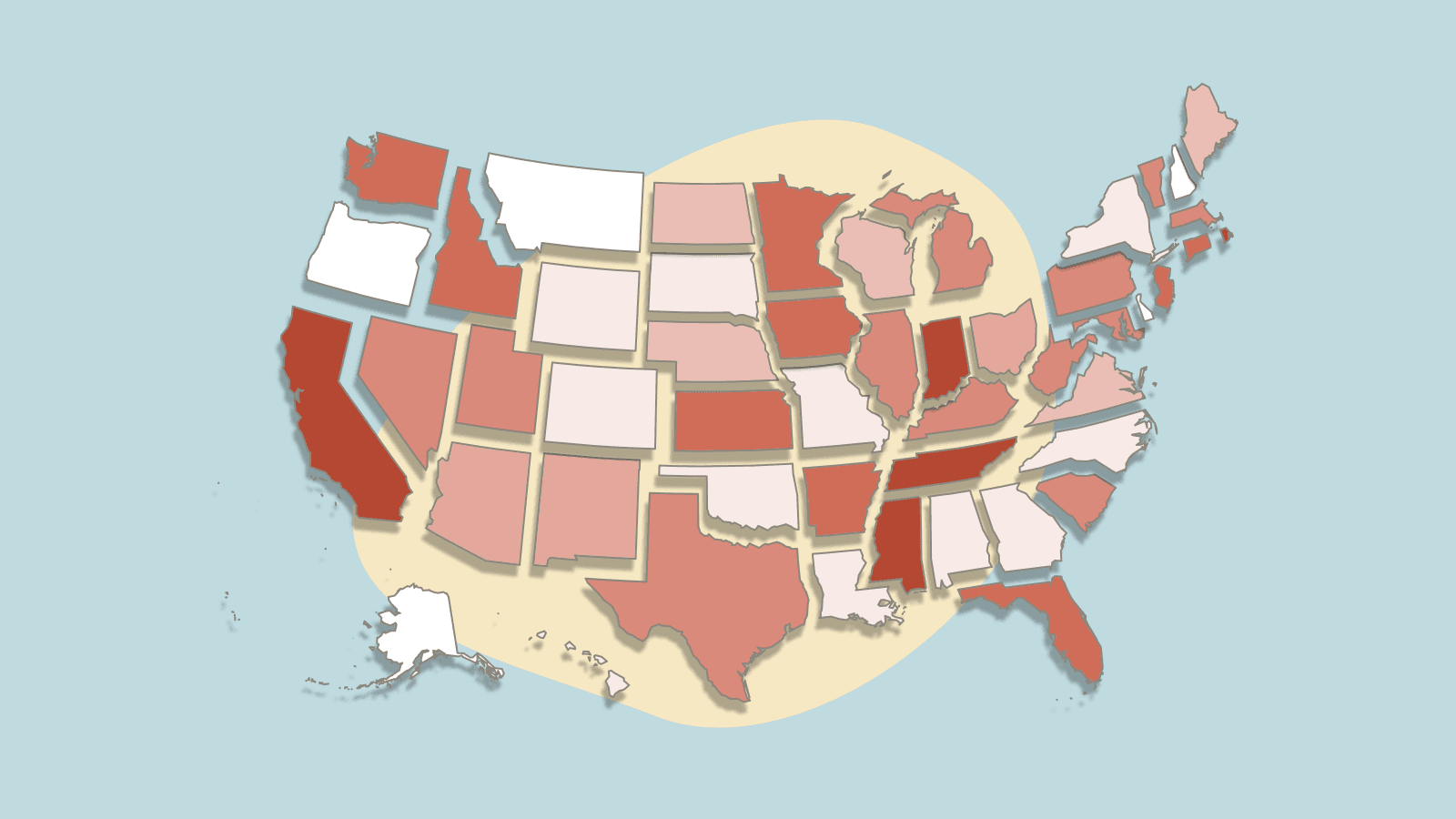
Different rules for sales tax by state are hard to navigate when your business sells in multiple places! Learn how to stay tax compliant and save time.

Quaderno vs TaxJar vs Avalara vs Stripe Tax: Which Wins?
Comparing TaxJar, Avalara, Stripe Tax, and Quaderno for your online business? We break down features, pricing, and limitations so you can choose with confidence.

What Is Streamlined Sales Tax? SST Explained for Sellers
Streamlined Sales Tax simplifies registration and filing across 24 US states, and it can get you free tax software. Here is how SST works and whether you should join.
SaaS Sales Tax by State: Is Your SaaS Taxable in 2026?
Which US states tax SaaS, which do not, and what changes on January 1, 2027. Check each state against its own tax authority, then see where you have to collect.