You're here:
What Is Streamlined Sales Tax? SST Explained for Sellers

You registered for sales tax in one Streamlined Sales Tax state, ticked the box, and moved on. Six months later a notice arrives from a state you have never filed in, and you discover that your SST registration never covered it. Nothing was wrong with your paperwork. You were just working from the wrong mental model of what SST does.
Short answer: Streamlined Sales Tax is a voluntary program through which 24 US states accept a single registration, share product definitions, and will pay for your compliance software if you qualify. It does not decide where you owe tax, and it covers none of the large markets outside the program, such as California and Texas.
By the end of this guide you will know which 24 states SST actually covers, what the SST program pays for on your behalf, the specific obligations it creates once you join, and a clear test for whether registering helps or hurts your business. No guesswork, and no assuming your sales tax compliance is handled when it is not.
First, which SST are we talking about?
The acronym is genuinely overloaded, and search results mix all of these together:
- Streamlined Sales Tax, the US multistate sales tax program. That is the subject of this guide.
- Sales and Service Tax, Malaysia's consumption tax administered through the MySST portal.
- SST, an open source framework developers use to build applications on AWS.
- Student Study Team, a process used in US schools.
If you sell into the United States and someone mentions SST, they almost certainly mean Streamlined Sales Tax. If you sell into Malaysia, they mean something completely different with its own registration thresholds and filing calendar.
What is Streamlined Sales Tax?
Streamlined Sales Tax is a voluntary cooperative program between US states, designed to make sales tax compliance less punishing across state lines. It exists because US sales tax is administered separately by each jurisdiction, and often by counties and cities on top of that. A seller operating in ten of them can face ten different registration processes, ten definitions of what counts as a taxable product, and ten filing calendars.
The effort that became the Streamlined Sales Tax Governing Board began in March 2000, well before remote sellers faced widespread collection duties. The states involved wrote their commitments into a document called the Streamlined Sales and Use Tax Agreement, usually shortened to SSUTA. In the Governing Board's own words, the purpose of the Agreement is "to simplify and modernize sales and use tax administration in order to substantially reduce the burden of tax compliance."
Three things follow from that, and they are what actually matter to a seller:
- One registration, many states. You complete a single application through the Streamlined Sales Tax Registration System and it registers you in every member state you select.
- Shared definitions. Participating states agree on common definitions for product categories, so a given product is classified consistently rather than differently in each state.
- Software paid for by the states. The SST program certifies software providers and, for sellers who qualify, those states pay the providers directly.
That third point is the one most sellers underestimate, so it is worth its own section below.
Which states are SST members?
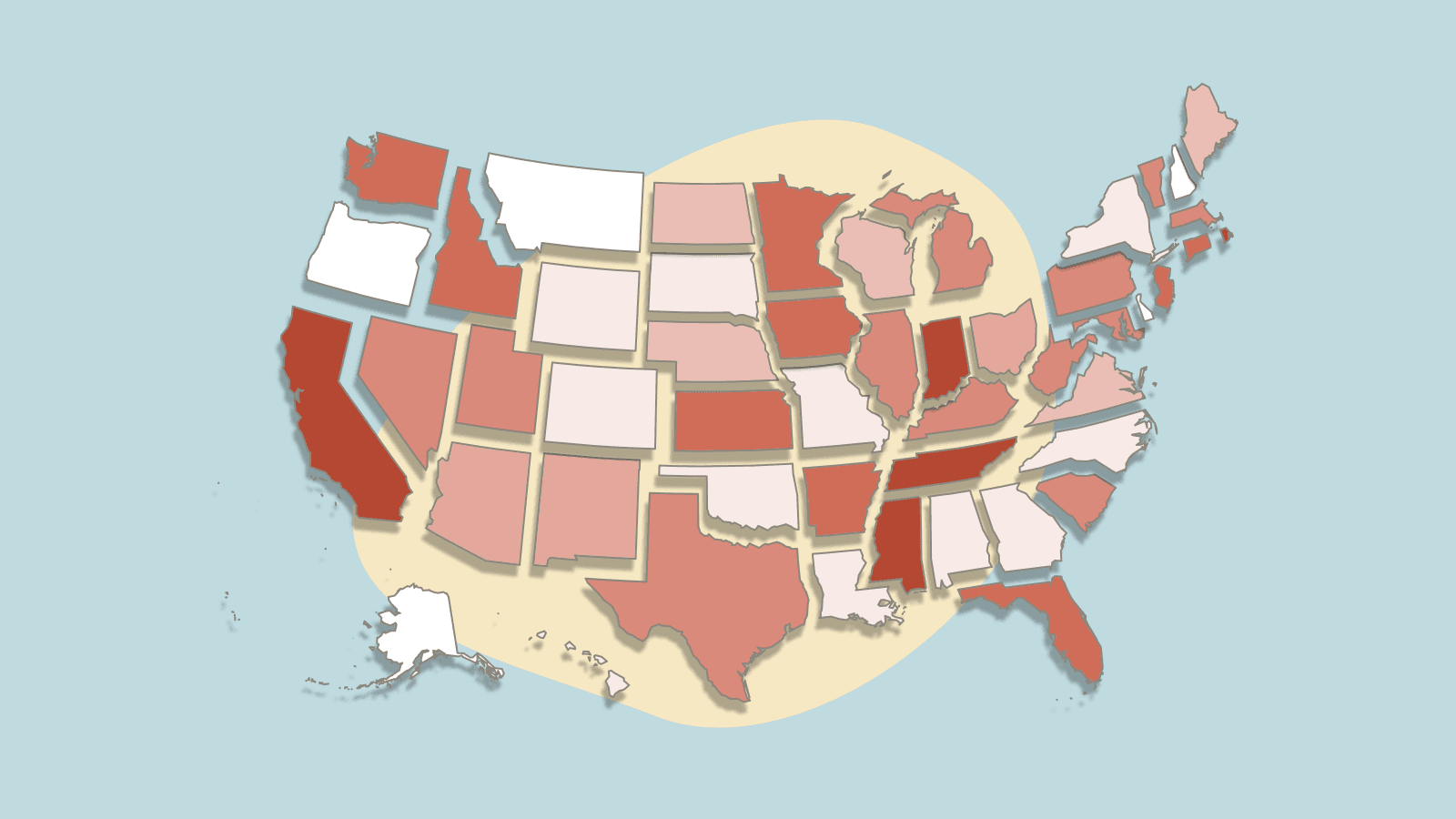
Twenty-four states have adopted the simplification measures in the Agreement. Twenty-three are full members, and Tennessee is an associate member, which means it has achieved substantial compliance with the Agreement taken as a whole rather than with every individual provision.
| Membership | Count | States |
|---|---|---|
| Full member | 23 | Arkansas, Georgia, Indiana, Iowa, Kansas, Kentucky, Michigan, Minnesota, Nebraska, Nevada, New Jersey, North Carolina, North Dakota, Ohio, Oklahoma, Rhode Island, South Dakota, Utah, Vermont, Washington, West Virginia, Wisconsin, Wyoming |
| Associate member | 1 | Tennessee |
| Non-state participant | 1 | Washington, D.C. |
Washington, D.C. participates too, though it sits outside the 24 figure because that count covers states only.
Membership does change as states join or adjust their status, so confirm the current roster on the Streamlined Sales Tax Governing Board site before you rely on it for a registration decision.
Now compare that list against the 45 jurisdictions that charge state sales tax. California, Texas, New York, Florida, Illinois, and Pennsylvania are all absent, and those are exactly where revenue concentrates for most growing businesses.
This is the single most important limitation of SST, and it is the reason the seller in our opening scenario got a notice.
What SST actually does for you
Free compliance software if you qualify
The SST program certifies companies called Certified Service Providers, or CSPs. A CSP calculates sales tax, files returns, and remits payment on your behalf in every participating state.
The unusual part is who pays.
If you qualify as a volunteer seller in a member state, that state compensates the CSP directly. You get calculation, filing, and remittance in that state without paying for it yourself.
Broadly, you are a volunteer seller wherever you have no physical presence and have not otherwise triggered an obligation to register under local rules. The precise test varies, so check each one before assuming a CSP will be covered for you.
One registration instead of many
The Streamlined Sales Tax Registration System lets you register across every participating state in a single application, and update or close registrations from the same place. If you would otherwise be completing separate applications in a dozen state portals, this is a real reduction in work.
Consistent product definitions
Participating states use agreed definitions for product categories. That matters most for sellers whose products sit in awkward categories, which brings us to digital goods.
Amnesty for past liability
States that join the Sales and Use Tax Agreement can offer amnesty for uncollected sales and use tax from before a seller registers, subject to conditions such as registering within a defined window and not having been already under audit. Amnesty terms are specific and time sensitive, so treat this as something to confirm for your situation rather than assume.
What SST does not solve
This is where most explanations stop, and where sellers get caught out.
- It does not cover non-member states. SST registration gives you nothing in California, Texas, New York, or anywhere else outside the program. If you have obligations there, you register there, separately, and you pay for that compliance yourself.
- It does not decide whether you owe tax. SST is a registration and administration layer. Whether you have a collection obligation in a state is determined by that state's nexus rules, including economic nexus thresholds based on your sales volume or transaction count. Work out where you have nexus first, then decide how to register.
- Registering creates real obligations. Once you are registered in a participating state, you are expected to collect and remit there, including for periods with no sales. Registering where you had no obligation means taking on filing duties you did not previously have.
- Volunteer status is conditional, not permanent. Open an office, hire staff, or store inventory in a member state and you may cease to be a volunteer seller there. The state stops paying your CSP fees, and you start paying them.
- It is not a single national filing. SST simplifies registration and standardizes definitions. It does not merge your state returns into one federal sales tax return, because no such thing exists.
SST and digital products
If you sell software, subscriptions, ebooks, courses, or any other digital product, SST matters to you in a specific way that generic guides miss.
Digital goods are the hardest category in US sales tax. States disagree about whether a downloaded ebook, a streaming subscription, and a SaaS license are the same kind of thing, and they write their statutes accordingly. The result is that identical products are taxed differently across state lines.
SST member states work from shared definitions for digital goods, which removes some of that inconsistency across the member group. That is a genuine benefit for digital sellers, and it is more valuable to you than to a company shipping physical inventory, because your product category is the ambiguous one.
Two cautions:
- Shared definitions do not mean shared treatment. A participating state can agree on what a digital good is and still decide independently whether to tax it, and at what rate.
- The definitions apply only within the member group, so everywhere else remains as inconsistent as ever.
For the full picture of how each jurisdiction treats digital products, including the non-member markets SST leaves untouched, see our state-by-state guide to US sales tax on digital products.
Should you register for SST?
Registration is voluntary. Nobody is required to join. Work through these questions in order.
- Where do you actually have obligations? Map your economic nexus first. If your obligations sit mostly in California, Texas, New York, and Florida, SST addresses none of them and the decision is close to moot.
- Would you qualify as a volunteer seller? This is the deciding factor for most sellers. If you qualify in a meaningful number of participating states, the CSP compensation is real money and real work removed. If you have physical presence across them, you likely will not qualify, and the main benefit evaporates.
- How many SST states would you register in? One or two, and the simplification is marginal. Ten or more, and consolidated registration plus paid-for CSP services becomes significant.
- Are you prepared to file everywhere you register? Registration is not free of obligation. Sign up in fifteen jurisdictions and you file fifteen returns, including zero returns for quiet periods. Do not register somewhere you have no obligation just because registration is available.
A reasonable summary: the SST program suits remote sellers with genuinely distributed sales and no physical footprint in the member group. For remote sellers concentrated in the large non-member markets, it solves much less of your sales tax compliance.
Whichever route you choose, the underlying work does not change. You still need to know where you have crossed a threshold, charge the correct rate on every sale, and file on time in each state.
SST changes who administers some of that and who pays for it. It does not remove it.
Sales tax that works in every state, member or not
SST helps in 24 states. Your customers are not that considerate about where they live.
Quaderno calculates the right sales tax, VAT, and GST on every sale automatically, in SST jurisdictions and non-SST ones alike, and tells you when you are approaching a threshold somewhere new before it becomes a problem. See how Quaderno Tax Engine works.
Note: At Quaderno we love providing helpful information and best practices about taxes, but we are not certified tax advisors. For further help, or if you are ever in doubt, please consult a professional tax advisor or the tax authorities.
Frequently Asked Questions
What is an SST?
In US sales tax, SST stands for Streamlined Sales Tax, a cooperative effort between 24 states to simplify and standardize sales and use tax administration. It is governed by the Streamlined Sales Tax Governing Board and formalized in the Streamlined Sales and Use Tax Agreement (SSUTA). The acronym also refers to unrelated things, including Malaysia's Sales and Service Tax, so context matters.
Is Streamlined Sales Tax registration required?
No. SST registration is entirely voluntary. You can register for sales tax directly with any individual state instead. SST is an alternative registration route that covers multiple states at once, not a legal obligation.
How many states are Streamlined Sales Tax members?
Twenty-four states have adopted the simplification measures in the Streamlined Sales and Use Tax Agreement. Twenty-three are full member states and Tennessee is an associate member, meaning it has achieved substantial but not complete compliance with the Agreement.
Does Streamlined Sales Tax cover all US states?
No. SST covers 24 states, which is fewer than half of the 45 states that levy a general sales tax. Major markets including California, Texas, New York, Florida, Illinois, and Pennsylvania are not SST members, so you must register with those states separately.
What is a Certified Service Provider?
A Certified Service Provider (CSP) is a company approved by the Streamlined Sales Tax Governing Board to calculate, collect, file, and remit sales tax on a seller's behalf in SST member states. If you qualify as a volunteer seller, member states pay your CSP fees rather than you.
Keep reading

US Sales Tax Guide: Everything You Need to Know
Whether you have a business in the US or you’re a remote seller with US customers, we’re here with a detailed Guide on US sales tax.
Sales Tax Nexus: A Complete Guide to Types, Laws, and Compliance
What is sales tax nexus? Learn the types (economic, physical, affiliate), how to determine nexus, and steps to comply with US sales tax laws.
State-by-State Analysis: Sales Tax Compliance for Multistate Businesses
Different rules for sales tax by state are hard to navigate when your business sells in multiple places! Learn how to stay tax compliant and save time.

US Sales Tax on Digital Products: State-by-State Guide
Sales tax on digital goods by state is tricky. Which states have sales tax? What's taxable? Learn everything here.

Quaderno vs TaxJar vs Avalara vs Stripe Tax: Which Wins?
Comparing TaxJar, Avalara, Stripe Tax, and Quaderno for your online business? We break down features, pricing, and limitations so you can choose with confidence.