You're here:
Excise Tax vs Sales Tax: What Sellers Need to Know
In this article
- What is an excise tax?
- Types of excise taxes
- What is the difference between an excise tax and a sales tax?
- How to calculate excise tax
- Who pays excise tax, you or your customer?
- Why governments implement excise taxes
- How the US compares internationally
- Does your business need to worry about excise tax?
- How to identify and track excise taxes
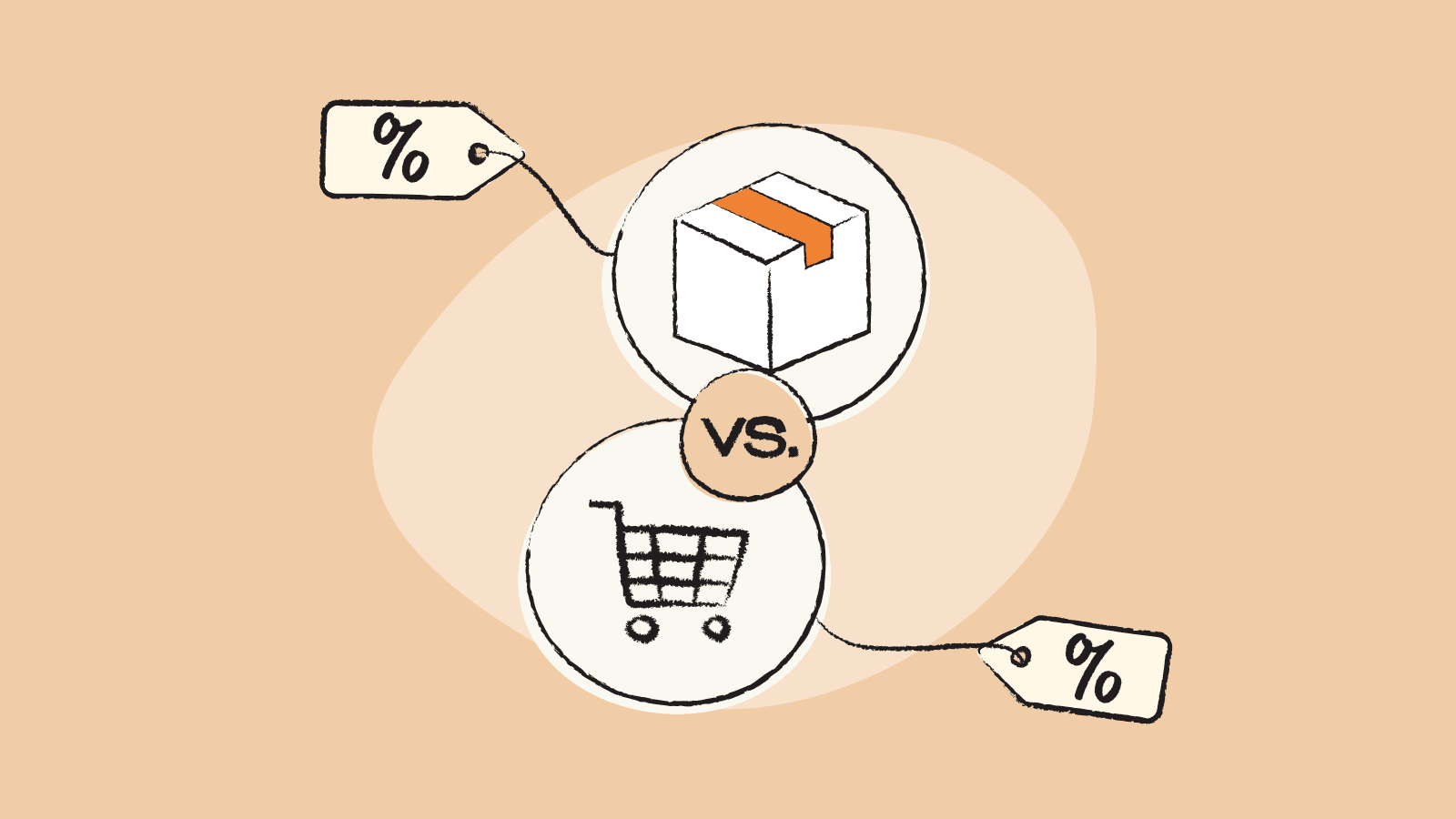
You're setting up tax collection for your store and you hit a line item you don't recognize: an excise tax on a product you thought was only subject to sales tax. You can't tell whether you're supposed to be collecting it, whether it's already sitting inside what your supplier charges you, or whether you've been under-collecting for months.
Here's the short version. Excise tax vs sales tax comes down to four things:
- What gets taxed
- Who legally owes it
- How it's calculated
- Whether your customer ever sees it
Short answer: An excise tax targets a specific list of goods and services and usually lands on the manufacturer or importer. Sales tax applies broadly at retail, lands on your buyer, and appears as its own line at checkout.
This post covers both from the seller's side. One clarification before we start: if you're here about vehicle excise tax on a car registration, or about Hawaii's General Excise Tax, those are different taxes that happen to share a name.
What is an excise tax?
An excise tax is a tax on specific goods, services or activities, imposed by the federal government, by states, or by both. Unlike sales tax, which applies to most of what a retailer sells, an excise tax only touches specific products and services named in a statute. The list is short and deliberate, built around goods or services governments want to fund from or discourage.
Fuel, tobacco, alcoholic beverages, air travel and sports wagering all carry excise taxes at federal level. So do some things you'd never guess: the IRS also collects excise on heavy highway vehicles, sport fishing and archery equipment, and corporate stock repurchases, the last at a rate of 1%.
Businesses that owe federal excise report it on Form 720, the Quarterly Federal Excise Tax Return. The parties who file are, in the IRS's own words, "importers, manufacturers, retailers, and consumers," and which applies varies with the tax. That variation is why the comparison confuses people.
Types of excise taxes
Excise taxes are calculated in three ways, and the method changes what happens to your pricing.
Specific excise tax
A specific excise is a flat amount per unit, charged regardless of what the item sells for. Federal gasoline tax runs at $0.184 per gallon, or 18.4 cents per gallon, and diesel at $0.244. Whether the pump reads $3 or $6, the tax is the same 18.4 cents per gallon.
Both rates were set in 1993 and have never been indexed for inflation. Cigarettes have sat at $1.01 per pack since 2009. For a seller, that predictability cuts both ways: your excise cost per unit never rises with inflation, but it never falls when your margins get squeezed either.
Ad Valorem excise tax
An ad valorem excise is a percentage of the amount paid, so it scales with value. Domestic air transportation carries a 7.5% federal tax on the fare, alongside a flat per-segment charge. Indoor tanning services carry 10%.
An ad valorem excise tax behaves much more like sales tax than a specific excise does, which is exactly why the two get confused.
Other excise taxes
The third group covers activity-based and one-off charges that follow neither pattern, such as taxes on wagering or stock buybacks.
State and local excise regimes sit on top of all this and don't mirror the federal list. States set their own rates on fuel, tobacco and alcoholic beverages, and states that have legalized cannabis or taxed vaping have written excise rules with no federal equivalent. If you sell a product subject to excise across state lines, assume the rules differ in every state.
What is the difference between an excise tax and a sales tax?
| Aspect | Excise tax | Sales tax |
|---|---|---|
| What it applies to | A specific statutory list of goods, services and activities | Most retail goods and services, minus exemptions |
| Who legally owes it | Usually the manufacturer, importer or distributor | The buyer, collected by the seller |
| Who remits it | Whoever the statute names, often not the retailer | The retailer, to each state where it has nexus |
| How it's calculated | Flat rate per unit, or _ad valorem_ on value | A percentage of the purchase price at the point of sale |
| Does the buyer see it | No, it's embedded in the shelf price | Yes, itemized at checkout |
| If you get it wrong | Back taxes fall on the liable party in the supply chain | Assessment, penalties and interest fall on you |
An excise tax is a targeted tax on particular goods and services, usually paid by the producer or importer and folded into the price before anything reaches a shelf. Sales tax is a broad tax on retail transactions, calculated as a percentage of what the customer pays and collected by the seller at checkout. For a business, the practical difference in excise tax vs sales tax is who carries the filing obligation.
1. Scope of excise tax vs. sales tax
Excise tax targeted on specific goods only
Excise applies only where a statute says it does, so it's a closed list you can check against: either your goods or services appear on it or they don't. Fuel, tobacco and alcohol dominate.
Sales tax as broad-based
Sales tax works the opposite way round. Everything retail is taxable unless a state has carved out an exemption, and states exempt different things. Groceries, prescription drugs and clothing are common exemptions, and a growing number of states now tax digital products.
That inversion is the most useful thing to remember here.
Excise is opt-in by list. Sales tax is opt-out by exemption.
That distinction explains most of the confusion between excise and sales tax.
2. Calculation of excise tax vs. sales tax
Excise tax as a flat amount
A specific excise is a fixed charge per unit sold, independent of the selling price. Ad valorem excise taxes are the exception, taking a percentage instead.
Sales tax as a percentage of sale price
Sales tax is nearly always a percentage of the transaction value, so it moves with the purchase price. Combined state and local sales tax rates vary across thousands of jurisdictions, which is why the arithmetic gets ugly at scale.
3. Visibility of excise tax vs. sales tax
Excise taxes built into prices
Excise is usually invisible at checkout. It was paid further up the supply chain and is already inside the figure on the label, so no separate charge appears on the receipt.
Sales taxes added at checkout
Sales tax is explicitly itemized at the point of sale. The consumer sees the rate and the amount, which is why buyers notice sales tax changes and almost never notice excise ones.
There's a consequence here that trips sellers up.
An embedded excise tax is still part of the amount you apply sales tax rates to.
How to calculate excise tax
Two methods, and the arithmetic is simple once you know which one applies.
Calculating a per-unit excise tax
Multiply units by the flat rate. A distributor moving 8,000 gallons of gasoline owes 8,000 × $0.184, or $1,472 in federal excise. Nothing about the retail value enters the calculation.
Calculating an ad valorem excise tax
Multiply the amount paid by the rate. A $420 domestic air fare carries 7.5%, so $31.50, plus the flat per-segment charge. Double the fare and the ad valorem excise doubles with it.
Does sales tax apply on top of excise tax?
This is the question that actually costs money, and almost nobody answers it.
Usually yes, and not because of a special rule. Excise is paid upstream and absorbed into your cost, so by the time you set a shelf figure the excise is simply part of it. Sales tax is calculated on what you charge, which means you end up charging tax on an amount that already contains tax.
Work it through on a $50 item carrying $4 of embedded excise tax at a 7% rate:
- The shelf price is $50, which already includes the $4 excise
- Sales tax is applied to the full $50, not to $46
- The customer pays $53.50
Charging on $46 instead would under-collect by $0.28 on one item, which becomes a real assessment across a year of orders. The exception to watch is a separately stated excise charge, which a handful of states exclude from the taxable base, much as they treat shipping. If you sell a product carrying its own excise line, check that state's rule rather than assuming.
Who pays excise tax, you or your customer?
The law names one party and economics moves the cost to another. Excise tax is the clearest everyday example of that gap.
- Legal incidence is whoever the statute obliges to file and remit. For most federal excise taxes that's the manufacturer, importer or distributor, which is why a typical retailer never files Form 720 despite selling taxed goods every day.
- Economic incidence is who bears the cost, and that's almost always the end consumer, because each link in the supply chain builds the tax into what it charges the next.
There are exceptions. The indoor tanning tax is collected the way sales tax is: the IRS specifies it's "paid by the person paying for the indoor tanning service and is collected by the person receiving payment." Where a statute is written that way, the service provider is in the same position as a retailer collecting sales tax.
For most online sellers the practical answer is this. You don't remit federal excise, but you pay it inside your cost of goods, and it sits inside the base your sales tax is calculated on. With sales tax you are nearly always the collector and the filer. Two taxes, two different positions.
Why governments implement excise taxes
Excise taxes give governments something a broad tax can't: precision. In 2025 they raised $106 billion, about 2% of total federal revenues, from a narrow base and without touching headline rates.
Revenue generation
Raising income or sales tax is politically expensive because it touches everyone. Taxing one category raises money from a far smaller group of voters, which is why excise rates change more quietly.
Funding specific needs
Excise revenue is often earmarked. Around 70% of it goes to trust funds rather than general spending: fuel taxes flow into the Highway Trust Fund and pay for roads and transit, with gasoline alone raising $27 billion in 2025. The people paying are broadly the people benefiting, and that link is easier to defend than general taxation.
Influencing healthier behavior
Taxing tobacco and alcohol raises their cost deliberately, aiming to reduce consumption and offset the public costs those products create. Whether it changes consumer behavior is debated; that it's the intent is not.
How the US compares internationally
The US uses excise taxes more narrowly than most of its peers, and leans on other taxes to make up the difference.
OECD comparison
The US ranks last of the 38 OECD countries for revenue from taxes on goods and services, which came to 16% of total US tax revenue in 2022. The reason is structural: there is no national VAT. Strip VAT and GST out of the comparison, though, and the US takes a higher share from goods and services taxes than the OECD average does.
Narrower definition
The US also draws the category more tightly. Where other countries treat any targeted consumption levy as an excise, the US list stays close to fuel, tobacco, alcohol, transport and a few regulated activities.
If you sell outside the US, the equivalent burden usually arrives as VAT or GST rather than excise, and those are taxes you collect yourself.
Does your business need to worry about excise tax?
For most of the businesses reading this, the honest answer is no.
If you sell software, subscriptions, online courses, ebooks or other digital products, excise tax almost certainly doesn't apply to you. Sales tax, VAT or GST almost certainly does, and those are the obligations with registration thresholds you can cross without noticing.
Excise matters if you sell or import:
- Fuel and other petroleum products
- Alcohol or tobacco
- Firearms and ammunition
- Air transportation
- Sports wagering
- Heavy trucks and trailers
- Certain regulated products taxed at state level, such as cannabis or vaping products
The test is simple. Excise is list-based, so check whether your product is on a list. Sales tax is exemption-based, so assume you owe it and check whether an exemption applies. Treating one like the other is where it goes wrong.
One thing we should be straight about: Quaderno automates sales tax, VAT and GST. We don't calculate, prepare or file federal excise returns such as Form 720. If you sell fuel or alcohol you need a specialist for that piece, and how sales tax works covers the part we do handle. Both sit under the broader category of indirect taxes, which is why they behave similarly at the till and completely differently on your filing calendar.
How to identify and track excise taxes
If excise does touch your products, the job is confirming what you owe and what's already embedded in what you buy.
Start with the IRS for federal excise and Form 720 categories, then each state's department of revenue for state-level rules. Our worldwide tax guides link out to every state's revenue department, which saves hunting for the right agency.
How to find excise tax information online
The more useful question is one no website can answer: ask your suppliers whether excise is included in the purchase price they invoice you. It sets your real margin, and it sets the base you calculate sales tax rates on. They rarely volunteer it and will almost always tell you if asked.
Then check your catalog against the statutory lists once a year. Products get added and state rules change, so something that carried no excise when you started selling it may carry one now. If you sell physical goods across borders, sales tax, VAT and GST on physical products walks through how these obligations stack up in practice.
Most online sellers will never file an excise return. Nearly all of them owe sales tax, VAT or GST somewhere. Quaderno calculates the right rate at checkout in every jurisdiction you sell into, and tells you when you're approaching a registration threshold you haven't crossed yet.
Note: At Quaderno we love providing helpful information and best practices about taxes, but we are not certified tax advisors. For further help, or if you are ever in doubt, please consult a professional tax advisor or the tax authorities.
Frequently Asked Questions
Is excise tax the same as sales tax?
No. An excise tax applies to a specific list of goods, services and activities, and the law usually puts the liability on the manufacturer, importer or distributor. Sales tax applies broadly to most retail purchases, and the retailer collects it from the buyer at checkout.
What's the difference between sales tax and excise tax?
Four things separate them: what gets taxed, who legally owes it, how it's calculated, and whether the buyer sees it. Excise is list-based, often charged per unit, and buried in the shelf price. Sales tax is default-taxable with exemptions, charged as a percentage of the price, and itemized on the receipt.
What are some examples of excise taxes?
Common US federal excise taxes cover fuel, tobacco, alcohol, air travel, sports wagering, indoor tanning and heavy highway vehicles. Gasoline is taxed at $0.184 per gallon and domestic air transportation at 7.5% of the fare. States add their own, and the lists rarely match the federal one.
Who pays excise tax?
The law names the party who must remit it, and that is normally a manufacturer, importer or distributor rather than the retailer. The cost is then usually passed down the supply chain into the retail price, so the consumer bears it economically without ever seeing it itemized.
Is excise tax deductible?
Excise taxes your business pays as part of buying inventory or operating generally form part of your deductible business costs rather than a separate deduction. Treatment depends on the tax and on how you account for it, so confirm the specifics with the IRS or your accountant before filing.
How is excise tax calculated?
Two methods. A specific excise is a flat amount per unit, such as $0.184 on every gallon of gasoline, and does not move when the retail price moves. An ad valorem excise is a percentage of the amount paid, such as the 7.5% federal tax on domestic air fares.
Keep reading

US Sales Tax Guide: Everything You Need to Know
Whether you have a business in the US or you’re a remote seller with US customers, we’re here with a detailed Guide on US sales tax.
US Sales Tax on Digital Products: State-by-State Guide
Sales tax on digital goods by state is tricky. Which states have sales tax? What's taxable? Learn everything here.
How does sales tax work on discounted goods?
Learn the complexities of applying sales tax to discounted products. From cash discounts to coupons, navigate the rules with this comprehensive guide.

How to handle sales tax for physical products around the world
Selling physical goods? Learn how VAT, GST & sales tax apply globally, and discover tools to simplify compliance across multiple countries.
What is indirect tax? A practical guide for small businesses
Learn how indirect taxes like sales tax, VAT, and GST affect pricing and compliance, plus tips to stay compliant worldwide and automate with Quaderno.