You're here:
What Is GST? Definition, Rates & Countries That Have It
GST, goods and services tax, is a consumption tax charged on most goods and services at each stage of production and distribution. It works the same way VAT does: collected incrementally along the supply chain, then remitted to the government. There are seven GST countries — Australia, Canada, India, the Maldives, New Zealand, Papua New Guinea and Singapore — and each sets its own standard rate and registration threshold, so the rules vary significantly if you sell internationally.
Short answer: GST is a consumption tax applied to most goods and services at each stage of the supply chain. It is used in Australia (10%), Canada (5% federal), India (18% standard), New Zealand (15%), Singapore (9%), the Maldives (8%) and Papua New Guinea (10%). All of them apply GST to foreign sellers above a certain revenue threshold.
Which Countries Charge GST?
The following countries use GST:
- Australia
- Canada
- India
- Maldives
- New Zealand
- Papua New Guinea
- Singapore
GST rates and thresholds at a glance
| Country | Standard rate | Registration threshold | Introduced |
|---|---|---|---|
| Australia | 10% | AUD 75,000 | July 2000 |
| Canada | 5% federal | CAD 30,000 | January 1991 |
| India | 18% | None for digital goods | July 2017 |
| Maldives | 8% | MVR 1 million | October 2011 |
| New Zealand | 15% | NZD 60,000 | October 1986 |
| Papua New Guinea | 10% | PGK 250,000 | 1999 |
| Singapore | 9% | SGD 1 million | April 1994 |
Rates and thresholds change. Check the relevant tax authority before you rely on a figure: Inland Revenue New Zealand, ATO, IRAS Singapore, CRA, MIRA Maldives, PNG Internal Revenue Commission.
GST in Australia
Implemented in July 2000, Australia's GST replaced multiple indirect taxes with a single, broad-based consumption tax. Most goods and services are taxed at a standard rate of 10%, with exemptions and zero-rated supplies. Mandatory registration kicks in for businesses with annual taxable turnovers exceeding AUD 75,000, although smaller businesses can opt for voluntary registration.
GST in Canada
Canada’s GST came on the scene in January 1991, pioneering the dual GST system. Under this system, both federal and provincial governments collect taxes on most goods and services. The federal GST, set at 5%, applies nationwide, while provinces levy the Provincial Sales Tax (PST), varying between 6% to 7%. Certain items like basic groceries, prescription medications, and exports are zero-rated. Businesses with an annual turnover exceeding CAD 30,000 must register for GST.
GST in India
Implemented in July 2017, India's GST system aimed to streamline the country's indirect tax structure. It operates on a dual model: the Central GST (CGST) is levied by the central government on intra-state transactions, while the State GST (SGST) is collected by states.
India rebuilt its rate structure on 22 September 2025, in what is widely called the GST 2.0 reform. The old five-band system collapsed into three: 5% for essentials, 18% as the standard rate, and 40% for luxury and sin goods such as tobacco and pan masala. The 12% and 28% bands were largely retired, with items moving up to 18% or down to 5%. Precious metals keep niche rates of 3% and 0.25%. Most digital services sold into India fall at 18%.
India is also the only country on this list with no registration threshold for foreign sellers of digital goods. One sale creates an obligation.
GST in Maldives
Introduced in October 2011, Maldives' GST system applies a standard rate of 8% (formerly 6%) to most goods and services, with exceptions for specific supplies. You must register for taxes if your annual taxable supply exceeds MVR 1 million over a 12-month period.
The Maldives runs a separate, higher rate for the tourism sector. Tourism GST (TGST) rose to 17% on 1 July 2025, up from 16%, and applies to resorts, guesthouses and other tourist services rather than to general commerce.
GST in New Zealand
Implemented in October 1986, New Zealand's GST system is often hailed as a model, influencing many other countries. It applies to all goods and services sold within the country. Businesses must register for GST if their annual turnover exceeds NZD 60,000. The standard rate of 15% is applied to most transactions, including imports. While some goods or services have zero-rated or exempt status, the system keeps exemptions and reduced rates limited.
GST in Papua New Guinea
Papua New Guinea’s GST arrived in 1999, originally under the name value added tax, and was renamed GST in 2003. The rate is 10% and applies to most goods and services. That said, exported goods and services are zero rated, and the supply of some goods and services are exempt, including medical, educational, and financial services. Any business or individual whose annual turnover exceeds K250,000 in a 12-month period must register for GST. Businesses with annual turnovers less than the threshold can register for GST on a voluntary basis.
GST in Singapore
Introduced in April 1994, Singapore's GST follows a value-added tax approach. The standard rate rose to 9% on 1 January 2024, after an earlier increase to 8% in January 2023. It applies to most goods and services, with exceptions for specific supplies. Businesses with annual taxable turnovers exceeding SGD 1 million must register for GST, though voluntary registration is possible below this threshold. Registered businesses file regular returns and remit collected taxes to authorities.
Which Countries Don't Have GST?
The most common question here is about the United States, and the answer is that the US has no GST and no VAT. There is no federal consumption tax at all. Instead, individual states, counties and cities levy their own US sales tax, charged only once at the final sale to the consumer rather than at each stage of the supply chain. Rates are set locally, which is why a single American order can carry state, county, city and special district tax stacked together.
The United Kingdom and every EU member state have no GST either — they run VAT instead. Same mechanism, different name.
Roughly 175 countries operate a GST- or VAT-style consumption tax, so the genuinely tax-free list is short: a few Gulf states that had not yet introduced VAT, plus small jurisdictions that fund themselves through customs duties or resource revenue. If you are selling internationally, assume some form of consumption tax applies until you have checked.
Is GST the Same as VAT?
Functionally, yes. Both are collected in stages along the supply chain, and both let registered businesses reclaim the tax they paid on their own inputs, so the tax lands on the final consumer either way. The difference is the label a country picked, not how the tax works.
The practical distinction that does matter is GST versus sales tax, which is a genuinely different mechanism:
- GST and VAT are charged at every stage of production and distribution, with credits flowing back to businesses along the way.
- Sales tax, as used in the US, is charged once, at the point of final sale, with no input credits.
That difference changes your invoicing, your record-keeping and what you can reclaim. Our breakdown of VAT, GST and sales tax covers where each one applies.
How GST Works: A Worked Example
"Collected at each stage" is the part that sounds complicated and isn't. Follow a single product through a supply chain in Australia, where the rate is 10%.
A supplier sells raw materials to a manufacturer for AUD 100. It adds AUD 10 of GST, so the manufacturer pays 110, and the supplier sends that 10 to the tax authority.
The manufacturer turns the materials into a finished product and sells it to a retailer for AUD 200, adding AUD 20 of GST. The retailer pays 220. But the manufacturer already paid 10 in GST on its own inputs, so it claims that back as a credit and remits only the difference: 20 minus 10, so 10.
The retailer sells the product to a customer for AUD 300, adding AUD 30 of GST. The customer pays 330. The retailer claims back the 20 it paid the manufacturer and remits 30 minus 20, so 10.
| Stage | Sale price | GST charged | Input credit | Remitted |
|---|---|---|---|---|
| Supplier | 100 | 10 | — | 10 |
| Manufacturer | 200 | 20 | 10 | 10 |
| Retailer | 300 | 30 | 20 | 10 |
The government collected AUD 30 in total, which is exactly 10% of the final AUD 300 price. Every business in the chain handled the tax but none of them absorbed it — each remitted only the tax on the value it added. The consumer at the end is the only party who paid GST without getting it back.
That is the whole mechanism, and it is why GST compliance is mostly bookkeeping: you need to know what you charged, what you were charged, and the difference between the two. If you sell to consumers rather than businesses, you are the last link in this chain, so the GST you collect is the GST you remit.
Does GST Apply If You're a Foreign Seller?
Yes, and this catches a lot of online businesses out. All seven GST countries extend the tax to overseas sellers of digital products and services, because governments want the tax on what their residents consume regardless of where the seller sits. Physical goods get taxed at customs; digital goods have no border to cross, so the obligation is written into law instead.
What triggers it is the country's registration threshold, measured against your sales into that country over a 12-month period — either the last twelve months or the next twelve you expect. Cross it and you must register, collect GST on your sales there, invoice correctly and file locally.
For the full sequence, including how to tell a B2B buyer from a consumer and when the reverse charge means you charge nothing at all, read when to charge GST.
Your GST Obligations
Just to make things even more confusing, the list above changes regularly as new countries adopt or change their tax policies. India rewrote its entire rate structure in September 2025. Singapore raised its rate twice in two years. Why deal with the hassle of keeping everything straight?
Quaderno handles all of this tax compliance for you, so that you can spend your time focusing on dominating the global market — on bettering your product, getting to know your customers, taking care of your employees, or whatever else matters more than stressing over tax details.
In fact, Quaderno can do all of the following:
- Calculate the right amount of tax to charge each customer, right on your checkout page.
- Automatically verify the GST numbers you receive from customers.
- Collect and store the customer location evidence that you need to get from every sale.
- Create and send invoices in multiple languages and currencies.
- Send invoices automatically.
- Help ensure you don’t overpay on your returns.
- Notify you when you’re about to pass a threshold and need to register in a new country.
- Notify you when any tax policies or rates change, so that you’re always in the loop.
And that’s only how Quaderno can help with GST. When it comes to EU VAT, US sales tax, and others around the world, or simply everyday invoicing and accounting, Quaderno jumps through all the hoops for you and presents your business data in a way that’s easy to understand. You can also see which countries we cover.
Now that you know where GST applies, the next step is working out when you actually have to charge it. Read when to charge GST, then our guide on how to prepare a GST return to get your numbers ready before the deadline.
Note: At Quaderno we love providing helpful information and best practices about taxes, but we are not certified tax advisors. For further help, or if you are ever in doubt, please consult a professional tax advisor or the tax authorities.
Frequently Asked Questions
Which countries have GST?
Seven countries run their national consumption tax under the GST name: Australia, Canada, India, the Maldives, New Zealand, Papua New Guinea and Singapore. Roughly 175 countries levy an equivalent tax, but most of them call it VAT rather than GST.
Does the United States have GST?
No. The US has no federal GST or VAT. Instead, individual states, counties and cities levy their own sales tax, which is charged only at the final sale to the consumer rather than at each stage of the supply chain. The UK and the EU also have no GST; they use VAT.
Is GST the same as VAT?
Mechanically they are the same tax: both are collected in stages along the supply chain, and both let registered businesses reclaim the tax they paid on their own inputs. The difference is naming, not method. A handful of countries chose the label GST and the rest chose VAT.
Which country has the highest GST rate?
India, which applies 40% to luxury and sin goods such as tobacco and pan masala. On standard rates, India's 18% is the highest, followed by New Zealand at 15%. Canada has the lowest federal rate at 5%, though Canadian provinces add their own tax on top.
Which country introduced GST first?
New Zealand, in October 1986. Its design kept exemptions and reduced rates to a minimum, and that simplicity is why later adopters, Canada and Australia among them, modelled their own systems on it.
Do I have to charge GST if my business is not based in a GST country?
Usually yes, once your sales into that country pass its registration threshold. Every country on this list applies GST to foreign sellers of digital products and services. India sets no threshold at all, so a single sale creates an obligation there.
Keep reading
When to Charge GST (And When You Don't Have To)
Whether you charge GST comes down to three things: your sales into the country, who your customer is, and where they are. Here's how to work through all three.
How to prepare a GST return
File returns and claim GST deductions in just minutes. These accounting and reporting tips will help you prepare and declare GST returns quickly.
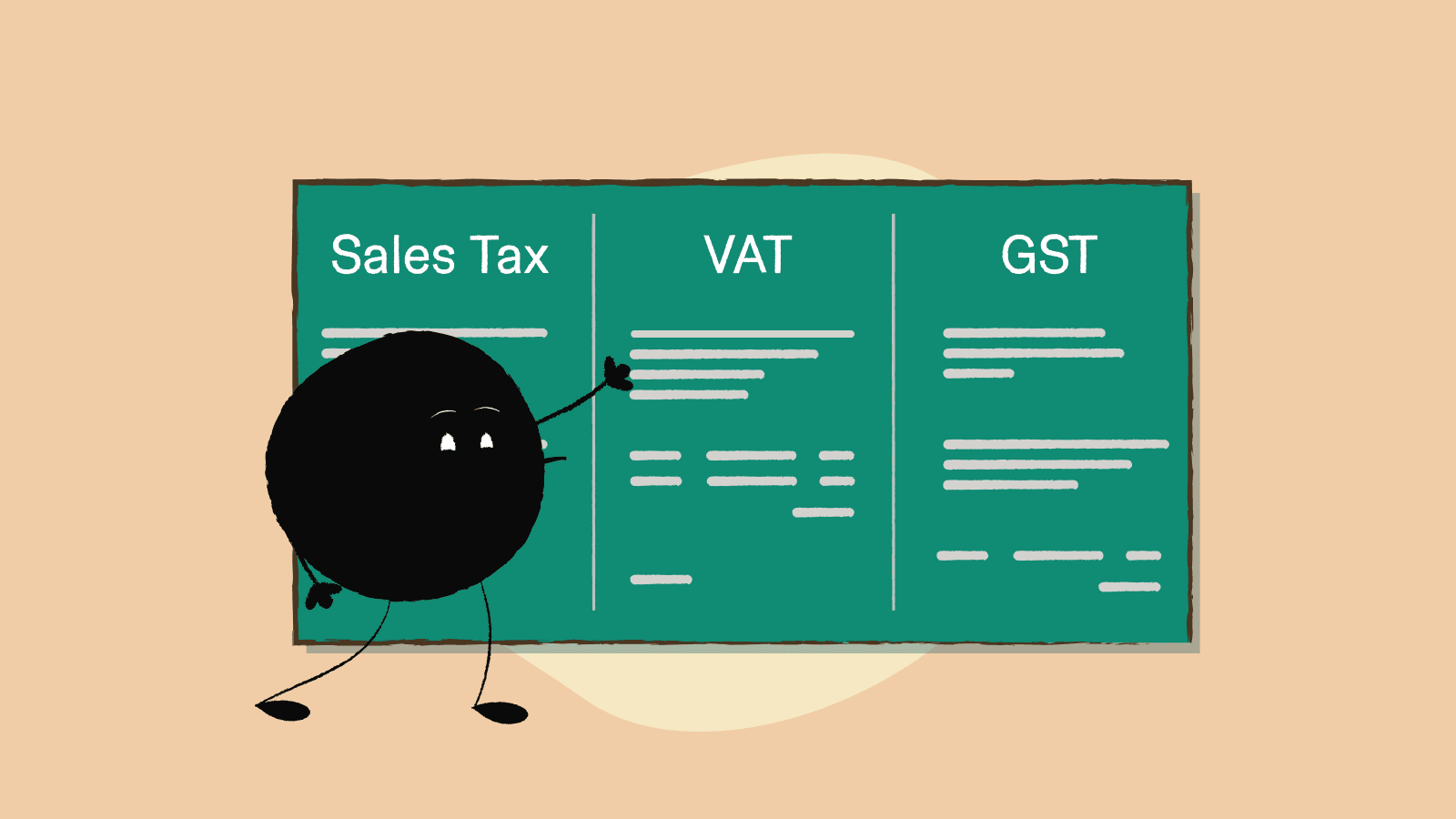
Sales Tax vs VAT vs GST - Your Guide to Consumption Taxes
What’s the difference between VAT, GST & sales tax? Learn how these taxes work worldwide and what your business must do to comply.