You're here:
E-Invoicing: What It Is, How It Works & EU Requirements
In this article
- What is e-invoicing?
- E-invoice vs. digital invoice vs. PDF invoice
- How e-invoicing works
- Where is e-invoicing mandatory?
- EU e-invoicing requirements: ViDA and national rollouts
- Country-specific e-invoicing requirements
- E-invoicing formats and standards
- Benefits of e-invoicing for businesses
- How to implement e-invoicing
- What to look for in e-invoicing software
- Frequently asked questions
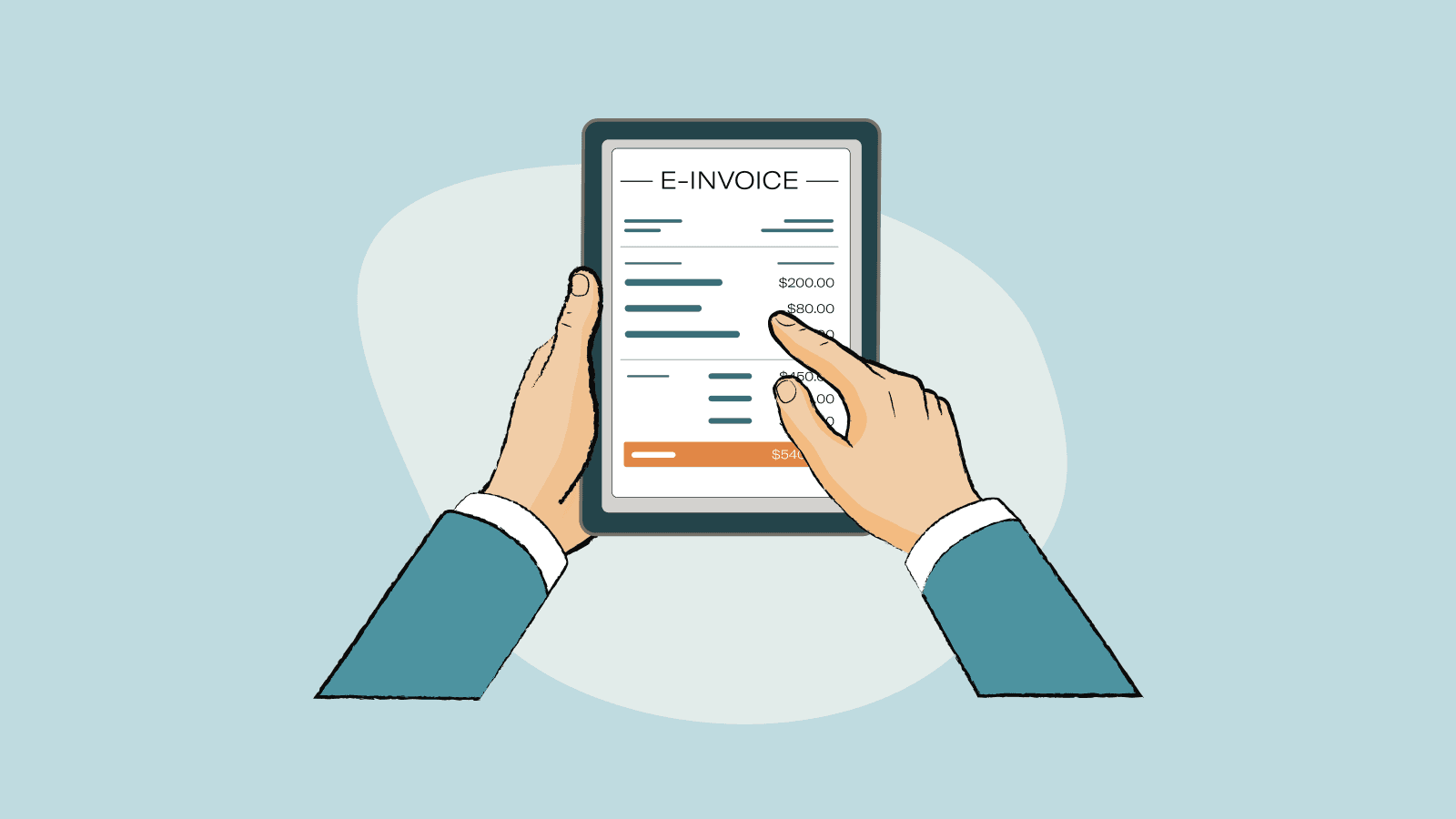
E-invoicing — electronic invoicing in a structured, machine-readable format — is rapidly becoming a legal requirement for businesses across Europe and beyond.
Unlike a PDF invoice sent by email, a true e-invoice is created in XML or a similar standard (such as Peppol BIS or UBL) and can be automatically processed by the recipient's accounting system without manual handling.
The EU's VAT in the Digital Age (ViDA) initiative is accelerating mandatory e-invoicing across all member states, with Germany, France, Spain, Italy, and Portugal already mid-rollout. If your business sells B2B in Europe, this is no longer optional — it's a compliance deadline.
What is e-invoicing?
E-invoicing, short for electronic invoicing, is the process of sending and receiving invoices in a specific, legally mandated digital format. Instead of a paper invoice or a PDF that has to be opened and read by a human, an e-invoice is a structured data file — typically XML — that can be ingested directly by the recipient's accounting or ERP system and processed automatically.
This distinction is critical: the word "electronic" in e-invoicing does not simply mean "sent by email." A PDF attached to an email is a digital document, but it is not an e-invoice. A true e-invoice carries its data in a machine-readable structure that eliminates manual entry at the other end.
For businesses, e-invoicing reduces errors, speeds up payment cycles, and makes tax reporting faster and more accurate. For governments, it provides a real-time or near-real-time view of economic activity, which is exactly why tax authorities around the world are mandating it.
E-invoice vs. digital invoice vs. PDF invoice
These three terms are often confused. Here is how they differ:
A PDF invoice is a digital version of a paper invoice. It can be sent by email, but the recipient must read it and enter the data manually into their own system. It has no machine-readable structure and does not qualify as an e-invoice in any jurisdiction with a formal e-invoicing mandate.
A digital invoice is a broader term for any invoice created or transmitted electronically. This includes both PDF invoices and true e-invoices, so the term on its own does not tell you whether the invoice is structured or not.
An e-invoice is a digital invoice in a standardised, structured format — such as XML, UBL, or Peppol BIS — that accounting systems can parse and process automatically. This is what governments and tax authorities mean when they require "e-invoicing." In countries with mandatory e-invoicing, submitting a PDF does not satisfy the legal requirement.
How e-invoicing works
The basics: from invoice creation to payment
Invoicing sits at the heart of the procure-to-pay (P2P) cycle. After goods or services are delivered, the seller raises an invoice against the agreed purchase order. With e-invoicing, this invoice is generated in a structured format by the seller's software and transmitted electronically — either directly to the buyer's system, or via a government platform, or through a network like Peppol.
The buyer's system receives the structured file, validates it automatically, and processes it for payment — all without manual data entry. Most invoices carry a net 30 payment term, though this varies by agreement and country.
Clearance model vs. post-audit model
The most important conceptual distinction in e-invoicing is between the clearance model and the post-audit model. These two approaches determine the entire implementation process and compliance obligation.
Clearance model: The seller submits the invoice to a government or tax authority platform before it is delivered to the buyer. The platform validates the invoice — checking tax calculations, format, and registration details — and either clears or rejects it. Only a cleared invoice can be sent to the buyer and is legally valid. Countries using this model include Italy, Mexico, Turkey, and Saudi Arabia. The clearance model gives tax authorities real-time visibility over every transaction.
Post-audit model: The seller sends the invoice directly to the buyer without prior government clearance. However, both parties must store the invoices in a compliant format and make them available to tax authorities on request — typically during an audit. The emphasis is on archiving, authenticity, and integrity. Germany and the UK broadly follow this model, though Germany's B2B mandate (introduced in 2025) requires businesses to be capable of receiving structured e-invoices even if the sending obligation is phased in later.
Understanding which model applies in each country where you operate is the essential first step in your e-invoicing implementation.
Types of e-invoicing transactions
E-invoicing applies across several types of commercial relationships:
B2G (Business to Government): Businesses send e-invoices to government agencies. This was the first area to be mandated in most countries and remains the most universally required. In the EU, B2G e-invoicing for public procurement has been mandatory since 2019.
B2B (Business to Business): Invoices between companies. This is the fastest-growing mandate area, with Italy leading the way since 2019 and most major EU economies rolling out B2B requirements between 2024 and 2028.
B2C (Business to Consumer): Less common, but some jurisdictions — particularly in Latin America — require structured e-invoices for consumer transactions as well.
Where is e-invoicing mandatory?
E-invoicing mandates are spreading rapidly. Over 60 countries have some form of mandatory e-invoicing as of 2026. Below is an overview of the key markets — always verify current deadlines with your local tax authority or adviser, as implementation timelines change.
Europe
| Country | Scope | Status | Format |
|---|---|---|---|
| Italy | B2G and B2B | Mandatory since 2019 | FatturaPA via SDI platform |
| Germany | B2G and B2B (receiving) | B2G mandatory since 2020; B2B receiving mandatory from Jan 2025; B2B sending phased to 2028 | XRechnung, ZUGFeRD |
| France | B2G | Mandatory via Chorus Pro | Factur-X, UBL, CII |
| France | B2B | Phased rollout: large companies from Sept 2026, all businesses from Sept 2027 | Factur-X, UBL, CII |
| Spain | B2G and B2B | B2G mandatory; B2B rollout underway via Crea y Crece law | Factura-e, Verifactu |
| Portugal | B2G and large B2B | Mandatory with certified software (ATCUD) | SAFT-PT |
| Romania | B2G and B2B | Mandatory since 2024 | RO e-Factura via ANAF |
| Belgium | B2B | Mandatory from Jan 2026 | Peppol BIS |
| Netherlands | B2G | Mandatory | Peppol BIS |
Outside Europe
| Country | Scope | Status | Format |
|---|---|---|---|
| Mexico | B2B and B2C | Mandatory since 2011 | CFDI via SAT |
| Brazil | B2B and B2C | Mandatory since 2008 | NF-e via SEFAZ |
| India | B2B above threshold | Mandatory since 2020 (thresholds apply) | e-invoice via IRP portal |
| Turkey | B2B above threshold | Mandatory since 2014 | e-Fatura via GİB |
| Saudi Arabia | B2B | Mandatory since Dec 2021 | XML via FATOORAH |
| United Kingdom | No B2B mandate | HMRC Making Tax Digital focuses on VAT returns, not e-invoicing | N/A |
| United States | No federal mandate | Some state-level requirements exist; federal procurement uses Peppol | N/A |
Quaderno supports e-invoicing compliance across multiple jurisdictions, including Verifactu in Spain — see how e-invoicing works in Quaderno.
EU e-invoicing requirements: ViDA and national rollouts
The EU's VAT in the Digital Age (ViDA) initiative is the most significant regulatory development affecting European businesses. Agreed in late 2024, ViDA introduces a series of measures to modernise VAT reporting:
Mandatory e-invoicing for cross-border B2B transactions: From 2030, all intra-EU B2B transactions will require structured e-invoices and near-real-time digital reporting to tax authorities. This replaces the existing EC Sales List (ESL) system.
Digital reporting requirements: Alongside e-invoicing, businesses will need to report cross-border transaction data within two days of the invoice being issued. This is a significant operational change for businesses with high volumes of EU cross-border sales.
Domestic B2B mandates remain national: ViDA does not impose a single EU-wide rule for domestic B2B e-invoicing. Each member state sets its own timeline and format requirements. This means businesses operating across multiple EU countries must comply with each country's individual mandate separately.
The practical implication: even if your domestic market does not yet require B2B e-invoicing, if you sell cross-border within the EU, you will need to be ready for ViDA's 2030 requirements. Starting your e-invoicing implementation now — rather than waiting for a deadline — makes compliance significantly smoother. You can also read more about EU digital reporting requirements and how they interact with e-invoicing mandates.
Country-specific e-invoicing requirements
Germany: XRechnung and ZUGFeRD
Germany uses two primary e-invoicing formats:
XRechnung is a pure XML format and is the mandatory standard for B2G e-invoicing in Germany. It has been required for invoices to federal public bodies since November 2020, and many regional authorities adopted it shortly after.
ZUGFeRD (Zentraler User Guide des Forums elektronische Rechnung Deutschland) is a hybrid format that embeds structured XML data within a human-readable PDF. This makes it accessible to recipients who do not yet have full e-invoicing systems, while still carrying machine-readable data. ZUGFeRD versions 2.0 and above are fully equivalent to the European standard EN 16931 and are compatible with France's Factur-X format.
For B2B transactions, Germany introduced a phased mandate in 2025. From January 2025, all German VAT-registered businesses must be capable of receiving structured e-invoices. Sending obligations are phased: large businesses (turnover above €800,000) must issue structured e-invoices from January 2027; all other businesses from January 2028. PDF invoices issued between consenting businesses remain permitted until these deadlines.
France: Factur-X and Chorus Pro
France's Chorus Pro platform has been mandatory for B2G invoicing since 2017 (phased by company size). For B2B, France is rolling out mandatory e-invoicing in stages, with large companies required to issue e-invoices from September 2026, and all businesses from September 2027.
Factur-X is France's domestic e-invoicing standard. Like ZUGFeRD, it is a hybrid PDF/XML format compliant with EN 16931. France also accepts UBL 2.1 and UN/CEFACT CII (Cross Industry Invoice) formats. The Portail Public de Facturation (PPF) — the national invoicing platform — will serve as the clearance hub for domestic B2B transactions.
Italy: FatturaPA via SDI
Italy has the most mature B2B e-invoicing system in the EU. Since January 2019, all B2B invoices in Italy must be issued in FatturaPA format and transmitted through the Sistema di Interscambio (SDI) — Italy's government-operated exchange system. This is a clearance model: invoices are submitted to SDI, which validates them and forwards them to the buyer. An invoice not transmitted through SDI has no legal validity in Italy.
Italy also requires structured e-invoices for cross-border (import/export) transactions, though the process for these uses a slightly different flow through the SDI.
Spain: Factura-e and Verifactu
Spain has two overlapping e-invoicing systems:
Factura-e is the XML format required for B2G invoicing in Spain, submitted via FACe (the government procurement platform). This has been mandatory for central government procurement for many years.
Verifactu is Spain's newer digital reporting and anti-fraud system, introduced under the Verifactu Regulation. It requires certified invoicing software that generates tamper-proof invoice records and reports them to the AEAT (Spanish tax authority) in real time. This applies to businesses required to use certified billing software. You can read our full guide to Verifactu in English.
For B2B e-invoicing more broadly, Spain's Crea y Crece law mandates that Spanish companies exchange e-invoices with each other, with implementation timelines that depend on company size and are being phased in from 2025 onwards.
E-invoicing formats and standards
XML (eXtensible Markup Language)
XML is the foundational technology underpinning most e-invoicing standards. It defines a structured, hierarchical way to encode invoice data that both humans and machines can read. Most country-specific e-invoicing formats are built on XML — including UBL, CII, XRechnung, and FatturaPA.
UBL (Universal Business Language)
UBL 2.1 is the most widely adopted XML-based standard for e-invoicing globally. It is the format used by Peppol BIS (the EU's cross-border e-invoicing standard) and is accepted in Belgium, the Netherlands, and many other countries. If you need a single format that works across multiple EU countries, UBL via Peppol is usually the safest choice.
Peppol BIS
Peppol (Pan-European Public Procurement On-Line) is a network and a set of standards for exchanging invoices across borders. Peppol BIS (Business Interoperability Specifications) defines how those invoices are structured and transmitted, and businesses connect through certified Peppol Access Points rather than to Peppol directly.
Peppol is mandatory for B2G e-invoicing in several EU countries and is the de facto standard for cross-border EU procurement. Our guide to the Peppol network covers the four-corner model, Peppol IDs, and whether you need your own Access Point.
ZUGFeRD / Factur-X
ZUGFeRD (Germany) and Factur-X (France) are effectively the same format — a hybrid PDF document with embedded XML structured data. Both comply with EN 16931, the European e-invoicing standard. This hybrid approach is useful for businesses transitioning to e-invoicing because the PDF layer remains human-readable while the XML layer enables automated processing.
FatturaPA
Italy's national format, FatturaPA, is an XML schema defined by the Italian tax authority (Agenzia delle Entrate). It contains specific fields required for Italian tax compliance and must be transmitted through the SDI platform. If you sell B2B in Italy, FatturaPA is non-negotiable.
XRechnung
Germany's pure XML standard for public sector invoicing. It is based on EN 16931 and does not include a human-readable PDF layer. It is the required format for invoices addressed to German federal government entities.
EDIFACT
EDIFACT (Electronic Data Interchange for Administration, Commerce, and Transport) is a UN-developed standard for electronic document exchange, predating modern XML standards. It remains common in industries with very high transaction volumes (logistics, retail) and is used by some large corporates who established EDI systems decades ago. For most businesses implementing e-invoicing for the first time, XML/UBL/Peppol is more practical.
JSON
JSON (JavaScript Object Notation) is a lightweight, human-readable data format gaining traction in e-invoicing, particularly for API-based integrations. Some countries and platforms are adopting JSON-based schemas as an alternative or complement to XML, though XML remains dominant in formal regulatory contexts.
Benefits of e-invoicing for businesses
The compliance argument for e-invoicing is clear — but the operational benefits are equally significant.
Faster payment cycles
E-invoices are delivered and processed in real time. Because the buyer's system can validate and approve the invoice automatically, there is no delay from manual processing or data re-entry. Businesses that switch to e-invoicing consistently report shorter invoice-to-payment cycles.
Fewer errors and disputes
Manual data entry is the primary source of invoice errors. Structured e-invoices eliminate this by transmitting data directly between systems. Fewer errors mean fewer disputes, fewer credit notes, and less time spent resolving payment issues.
Legal compliance
In countries with e-invoicing mandates, compliance is not optional. Using compliant e-invoicing software means you meet legal requirements automatically, reducing the risk of penalties for incorrect invoicing.
Better cash flow management
With faster processing and fewer payment delays, businesses can forecast cash flow more accurately and maintain healthier liquidity.
Simpler tax reporting
Structured e-invoice data maps directly to the fields required for VAT returns and digital reporting submissions. Instead of re-entering data at reporting time, it is already captured in the right format.
Reduced environmental impact
Eliminating paper invoices and physical document storage reduces paper use and the energy associated with printing, posting, and archiving physical records.
How to implement e-invoicing
The right implementation path depends on which countries you operate in, whether they use a clearance or post-audit model, and the volume of invoices you issue. Here is a step-by-step framework:
1. Identify which mandates apply to you
Map every country where you have customers or suppliers and check whether e-invoicing is currently required — and for which transaction types (B2G, B2B, B2C). Pay attention to thresholds (some mandates only apply above a certain revenue level) and phase-in dates. Regulations change frequently, so verify against official tax authority sources or work with a tax adviser.
2. Choose your connection method
Depending on the country, you will need to connect to:
- A national platform directly (e.g., SDI in Italy, Chorus Pro in France, FACe in Spain, ANAF in Romania)
- The Peppol network via a certified Peppol Access Point (most practical for multi-country EU compliance)
- A direct API connection to your software provider's e-invoicing service, which handles the platform connection on your behalf
For businesses operating in multiple EU countries, a Peppol Access Point typically offers the broadest coverage with the least implementation overhead.
3. Map your invoice data to the required format
Each e-invoicing standard has mandatory data fields. Review your current invoice template against the required fields for each country format — common gaps include missing VAT identification numbers, incorrect tax point dates, or non-standard product/service codes. Your e-invoicing software should handle the mapping, but you need to ensure your source data is complete.
4. Integrate with your accounting system
Choose e-invoicing software that integrates with your existing accounting or ERP system. Ideally, invoice data flows automatically from your accounting system into the e-invoicing format without manual export/import steps. Look for software that offers an e-invoice API if you want to build a tighter integration.
5. Test before go-live
Most national platforms and Peppol-connected services offer sandbox or test environments. Send test invoices through the full flow — generation, transmission, receipt, and validation — before switching over to live invoices. For clearance-model countries like Italy, test that your format passes platform validation before any real transactions.
6. Notify trading partners
If you are sending e-invoices to customers or suppliers for the first time, communicate the change in advance. Make sure they have the technical capability to receive the format you will use. For Peppol, they will need a Peppol ID; for national platforms, they need to be registered on the relevant system.
7. Set up compliant archiving
Every country with e-invoicing requirements specifies how long invoices must be stored and in what format. Germany requires 10 years; France requires 10 years; Italy requires 10 years via SDI. Your e-invoicing software should handle archiving automatically and ensure the stored format remains legally valid (including any digital signatures).
What to look for in e-invoicing software
Integration with existing systems
Ensure the software integrates with your current accounting, ERP, and payment systems. Look for an e-invoice API if you need a programmatic connection.
Supports the formats and countries you need
Not all e-invoicing software supports all formats. If you operate in Italy, you need FatturaPA. If you need cross-border EU coverage, you need Peppol. If you sell in Germany, you need XRechnung or ZUGFeRD support. Make sure the software covers every country where you have a compliance obligation — and that it stays updated as new mandates come into force.
Covers both outgoing and incoming invoices
Choose software that handles both sending (accounts receivable) and receiving (accounts payable) e-invoices. Processing incoming structured invoices automatically is as valuable as sending them.
Peppol access point certification
If you sell to government agencies or across multiple EU countries, look for a provider that operates a certified Peppol Access Point or partners with one. This gives you the broadest network reach with a single integration.
Archiving service
Look for software that archives e-invoices automatically in a legally compliant format, with the required retention period per country. Some countries require digital signatures on archived invoices to prove integrity.
Long-term legal compliance
Tax law changes regularly. Choose a provider that monitors regulatory developments and updates the software automatically — so you do not have to track every change in every jurisdiction yourself.
Additional tax compliance
Opt for e-invoicing software that also handles tax calculation and reporting. Automatically calculating taxes at the point of sale and generating tax reports from the same dataset reduces double-handling and ensures your invoices and returns are always consistent.
Technical support
Make sure the provider offers responsive support. E-invoicing errors can block payments — you need help when something goes wrong, not a ticket queue with a 48-hour SLA.
Frequently asked questions
Is e-invoicing mandatory in the EU?
E-invoicing is already mandatory for B2G (business-to-government) transactions across the EU. For B2B transactions, requirements vary by member state: Italy has required mandatory B2B e-invoicing since 2019, Germany introduced a B2B receiving obligation from January 2025 (with sending phased to 2028), and France is phasing in B2B mandates through 2026–2027. The EU's VAT in the Digital Age (ViDA) initiative will require structured e-invoicing for all intra-EU cross-border B2B transactions from 2030. Always check the specific requirements for each country where you operate.
What is the difference between an e-invoice and a PDF invoice?
A PDF invoice is a digital document that looks like a traditional invoice but must be read and entered manually — it has no machine-readable structure. A true e-invoice is created in a structured format (such as XML or Peppol BIS) that accounting systems can read and process automatically without human intervention. This distinction matters for compliance: in countries with e-invoicing mandates, a PDF sent by email is not a valid e-invoice.
Which countries require e-invoicing?
Italy, Mexico, Brazil, India, Turkey, and Saudi Arabia are among the countries with the most established e-invoicing mandates covering B2B transactions. Within Europe, Germany, France, Spain, Portugal, Romania, and Belgium are at various stages of B2B rollout. The list is growing rapidly — over 60 countries have some form of mandatory e-invoicing as of 2026, and the EU's ViDA framework will extend cross-border requirements significantly from 2030 onwards.
How do I implement e-invoicing for my business?
Start by identifying which mandates apply to your business and whether the countries involved use a clearance model (invoices must be approved by the tax authority before delivery) or a post-audit model (invoices go directly to the buyer but must be archived for government review). Then choose e-invoicing software that supports the required formats and connects to the relevant national platforms or the Peppol network. Test thoroughly before go-live and confirm your archiving setup meets local legal retention requirements.
What format should my e-invoices be in?
The required format depends on the country. Germany uses XRechnung (for B2G) and ZUGFeRD (a hybrid PDF/XML format). France uses Factur-X. Italy requires FatturaPA. Spain uses Factura-e, with Verifactu for digital reporting. Many EU countries support UBL 2.1 via the Peppol network. If you sell across multiple EU countries, using a Peppol-compatible format through an accredited access point is often the most practical approach, as it is accepted by most national systems.
Note: At Quaderno we love providing helpful information and best practices about taxes, but we are not certified tax advisors. For further help, or if you are ever in doubt, please consult a professional tax advisor or the tax authorities.
Keep reading

What is Peppol? How the e-invoicing network actually works
Peppol moves invoices between businesses across borders. Here's how the network works, who governs it, whether it's mandatory for you, and why you probably don't need your own Access Point.
E-Reporting in the EU: Digital Reporting Requirements
E-reporting sends transaction data straight to a tax authority, with no invoice involved. Here is how it works, which European countries require it, and what changes in 2030.